

















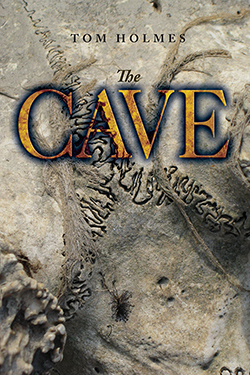
The Cave by Tom Holmes. Winner of The 2013 Bitter Oleander Press Library of Poetry Book Award Released by Bitter Oleander Press (10-6-14).
Comments
A deep and selfless imagination anchors The Cave. Tom Holmes gives himself over completely to his vision and his project is nothing less than inhabiting the spirit and the flesh of our collective ancestors. The speakers here, in the daily specifics of early life on earth, retell the beginnings of our consciousness as it rises from fire and rocks to images illuminated on the cave walls and in the night sky. Each poem is a distillation of the individual efforts of art that result in the common bonds of our humanity. From “blood on his finger” and “burnt wood and ash” to “where the wind took form” we retrace our physical and spiritual past in song and paint. The voices in these poems are absolutely credible, and Holmes’ writing is “a song it carries from a star.”
– Christpoher Buckley, author of Back Room at the Philosopher's Club
A writer looks at the famous Paleolithic cave paintings in France, and then he becomes an ancestor at art’s birth, birthing himself as a writer at the same time. Tom Holmes “set down [his] bowl of burning animal fat / to illuminate this hollow the world” in poems that embrace what it means to be a fledgling human and nods toward Platonic allegory in poems that delight and sometimes sear. In “An Origin of the Other” the sacred and the earthy conjoin in manifesting this human world, what we have been, what we have become and are becoming still. An ambitious and strange book of intelligence and empathy.
– Laura McCullough, author of Rigger Death & Hoist Another
Hand art on Paleolithic cave walls is the artery, but observations like cut gemstones are woven into Tom Holmes’ exciting tapestry of The Cave with its hunger for mystery to balance you along the edge: “When the wall opens, / I am lightning in the antelope’s antlers / and the stripe along its jaw.” These poems wrestle with the concept of time. They want to capture time, yet realize that time is elusive. So, they attempt to understand time through concrete experience, which poses its own dilemma. Even “The Needle,” a vehicle which hopes to stitch the fabric designed to apprehend time, is ephemeral: “Let me tell you about the needle. / It is and it is not. It points / to what will be, and what it isn’t. . . .” Undeterred, the poet continues his quest. Enjoy this exciting journey through the primordial future.
– Alan Britt, judge for the 2013 Bitter Oleander Press Library of Poetry Book Award
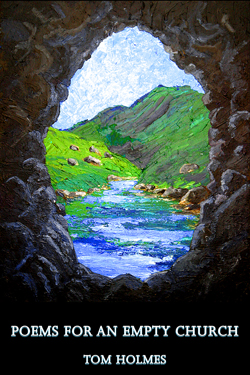
Poems for an Empty Church by Tom Holmes. Released by Palettes & Quills (9-1-11).
Comments
Of course, no church is ever really empty unless people let ritual and myth lapse into repetition and dogma. Even then it isn’t empty, just empty of awe. That’s when origin stories are most necessary, and that’s what Tom Holmes provides in abundance: Moons create amazement, then stones create reflection, then people come along creating words, aggression, fire, flutes, art, physics, and probably our destruction, everything progressing ’til it returns full circle. Along the way, “statues pry themselves from sides of buildings / and exit the city / clutching their plaques.” Along the way, a lot of fine poems unfold, one containing a curse: “you have succeeded / in being only what you thought / you should be.” It’s a curse because we ought to be more. In a century in need of a giant do-over, Poems for an Empty Church reminds us of that. Even better, it makes a good lever or spark.
– Rob Carney, author of Story Problems, Weather Report, and Boasts, Toasts, and Ghosts
In Poems for an Empty Church, Tom Holmes writes of birth and death and the life we live in between those two events in beautifully sculpted lines carved into the white space that surrounds them. “I dare say I can hear / muddy angels singing /the lines of God,” he writes in “The Calculus of a Tod Marshall Book of Poems.” There are plenty of angels in Tom Holmes’ poems too, but one must be still enough to hear and appreciate the whisk of wings hovering over these powerful meditations.
– Sarah Freligh, author of Sort of Gone
I think of Charles Olsen when I read Tom Holmes’ poems: open, investigative, prophetic, often with mystical implications. These are the elements of our best modernist poems, and Holmes is a modernist – or a pre-modernist, or a post-pre-modernist. And there lies the real interesting part of his poems, they are hard to fit into anyone anywhere. He sits us in an empty church and says listen. He knows “it was the moons talked first.” He knows the dreams we dream even when “we wheeze / asleep in our boxes of shadows.” In these poems and parables is our collective of fire and nightfall, origins and endings, monochromatics, rivers, and stretch marks. Sappho makes a rare presence, but this is a book more stone-carved than page-written and she too is an ancient muse. As this author’s I is an absent eye, scanning the world of caves and shadows to find clouds who feed themselves, ghosts like alphabets, and men who whittle bones into flutes.
– Sean Thomas Dougherty, author of Sasha Sings the Laundry on the Line and Broken Hallelujahs
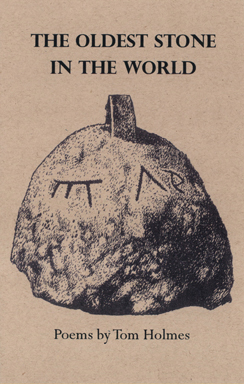
The Oldest Stone in the World by Tom Holmes. Released by Amsterdam Press (1-1-11). It is the first book released in 2011. Be a part of history and order a copy now.
Comments
Tom Holmes has given us a Stone for the ages, a physical metaphor for the tension between our anxiety about death and our fierce compulsion to live fully. The language is simple, but the electric effect of its surprising associations and vision propels us into vast new landscapes of possibility. Almost Jungian in its effect, the work vibrates with mystery and significance, and readers will find that the Stone has a tendency to speak quietly to them long after the book is put away.
– Wanda Schubmehl
What a tremendously generous gift! Written about ten years ago, Tom Holmes shares some of his vital early work. Imagine a collection with a literary conceit rivaling Louise Gluck’s in The Wild Iris and with the influence of Donald Revell’s more spare lyrics. By reading Holmes’ past work, I can’t imagine what the future will bring. All I know is this: I can’t wait to read it.
– Steve Fellner
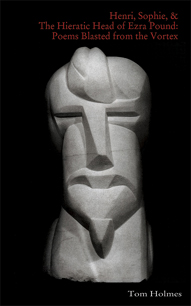
Henri, Sophie, & The Hieratic Head of Ezra Pound: Poems Blasted from the Vortex by Tom Holmes. Released by BlazeVOX Books (August 2009).
Comments
Part history, part aesthetic statement, part obsession, Henri, Sophie, & The Hieratic Head of Ezra Pound: Poems Blasted from the Vortex is, most of all, a lyrical exploration of life lived like the sharp cut of a chisel through marble. Henri Gaudier-Brzeska knew that blade hewing stone could reveal energy, that art was controlled energy; Holmes’ poetry – sharply chiseled – both maintains the formal precision of a cut through rock and the passionate intensity of the lives it follows – simply, these poems allow us to see that Henri and Sophie lived in the intense heat of lives blasted out of an important historical moment. This is no small accomplishment. Pound wrote, “Only emotion endures.” Holmes has written of a compelling story in a fine collection of poetry that shows Pound’s assertion to be accurate.
– Tod Marshall, author of The Tangled Line (Canarium Books, 2009) and Dare Say (University of Georgia Press, 2002).
Tom Holmes is often asking questions into the ether. One such recent question wondered who is making the new language, who has a fresh perspective on our poetry? In a roll-back-the-clock kind of way, Tom has answered that question with this book. He has managed to invigorate an under-appreciated branch of Modernism and reconstituted it for contemporary readers, achieving a hybrid of the archaic and the new, which is wholly enjoyable to read.
—Thom Caraway, author of A Visitor’s Guide to North Dakota (Finishing Line Press, 2007).
Poetry Assignments: The Book by Tom Holmes. Due out in September 2007 from Sage Hill Press. Tentatively priced at $20. Reserve a copy now, and receive a 40% discount. Contact Sage Hill Press at: sagehillpress@yahoo.com. Early Comments
"Pilgrims, what's not to love about this wacky cubist text — begin reading anywhere — that wants to make poetry fun again, that tells us to work an owl into any old poem, that describes the Pintist movement as a possible cyclic beginning point, that cajoles us toward exercises that might enable us to write poems that are "most cool"? For batter or verse, there's no other creative writing romp as off-the-wall & semi-schizoid as this one. Plunk down your dough & you'll be baking poems in the margins of Tom Holmes' mind, & you'll be happier for it."
— William Heyen
National Book Award Finalist
Shoah Train: Poems (Etruscan P, 2003).
"If Dickinson had bumped into Whitman at Pfaff’s, and tippled a few too many, she’d need this book to get back on track. If M. Proust had torn down all those corks, and started breaking his serpentine lines into verse, this book, translated into French, would be a fine DIY manual. If Mandlestam had the energy to march his way into one more bone-wringing elegy, this collection of high-wire assignments would help him get it done. If Beckett had written a textbook on poetry, then chucked the thing into the Liffey, and Uncle Seamus had pulled it out years later and dried it by the turf fire, it might look something like this. And so I say to poets, far and near, living and dead, Tom Holmes' Poetry Assignments will rattle your lyrical cages. It will make your Muses rise up, dervish-like, and whirl. It will unhinge and unjamb the hinges and doors of your lyrical houses, jostling the speed bumps on your iambic roads. It’ll get you writing in ways you didn’t even know you didn’t know before you knew them. And best of all, it may put all those fancy-pants MFA programs out of business for good! So make your assignations with these assignments and go forth and write."
— The ghost of Baudelaire, conjured by James Merrill’s Ouija Board
"For a while now co-editor Tom Holmes has been posting poetry assignments on the Redactions: Poetry & Poetics journal's website www.redactions.com. I liked that, yes, but would rather have a book.
"Presto! Inside these covers, you'll find those assignments — 100 kick-starts, nudges, ally-oops, particle colliders, and so on — all offered up as ways to help you generate drafts. And what more could you ask for? A hundred formulas? A hundred how-to's? I hope not. What I mean is this book is a time-saver not a short cut; there's a difference. What I mean is, for the last fifteen years, without knowing it, I've used versions of twenty of these. If I'd had this book all along, I might have saved some time. You can too. Assign it to your workshop students. Get it for yourself, and dig in. It's a good book, written like a good conversation. And it's useful. Like a corkscrew. Like a fork."
— Rob Carney
Author of author of New Fables, Old Songs (Dream Horse Press, 2003); This Is One Sexy Planet (Frank Cat P, 2005); and Boasts, Toasts, and Ghosts (Pinyon P, 2003), winner of the 2004 Utah Book Award for Poetry.
"Exercises: I, too, dislike them, and the reason is that in many writing books exercises focus on matters of craft in an attempt to help poets develop crafty competence. This is okay; unlike running with scissors, no one gets hurt. But craft exercises never yield 'imaginary gardens with real toads in them.' Tom Holmes and the editors of Redactions have done poetry a service by gathering exercises that will do just that: these witty, evocative, and engaging exercises are attempts to find a place for the genuine, and any spur to the imagination that can do that should be enthusiastically applauded. Bravo."
— Tod Marshall
Author of Dare Say (Winner of the Contemporary Poetry Series Competition. University of Georgia Press, 2002) and editor of Range of the Possible: Conversations with Contemporary Poets (EWU Press, 2002) and Range of Voices: A Collection of Contemporary Poets (EWU Press, 2005).
Where will you, fellow poet, be without Poetry Assignments: The Book? Assignments because Tom Holmes recognizes the poet has one assignment — to write. If the poet doesn’t write, he will be nowhere. Theses assignments will get you somewhere, & there are a lot of wheres to visit in these assignments — some wheres you’ve never been. And so I invite you poets to a new where.
— Semlohsa Moht
Poet Laureate of the former Gegôré.
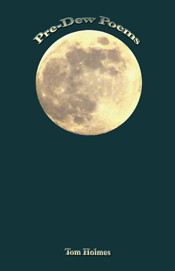
Pre-Dew Poems by Tom Holmes. From FootHills Publishing (June, 2008. $8.)
Early Comments
Tom Holmes’s Pre-Dew Poems possesses a masculine rawness that masterfully rides on the edge of sentimentality, but is restrained just enough not to cross over. When I read Holmes, I want to strip my world of excess. These poems shine a light through the haze of minutia and remind us of what truly matters.
—Dan Morris
Following the Day
At last, a man who can express love without getting me sick. I’m sure the poems speak on some sappy personal level for Tom, but to me they express love in the universal. These poems confront the myths, the imaginings, and the realities of love. Pre-Dew Poems is fulfilling, like a good fuck.
—Semlohsa Moht
Former Poet Laureate of the former Gegôré
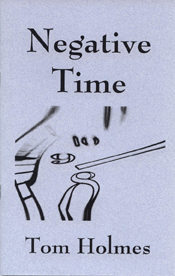
Negative Time by Tom Holmes, from Pudding House Publications. $10.
From the preface:
The following poems were sent to me from another universe. They are part of a correspondence between Semlohsa Moht, former Poet Laureate of the former Gegôré, and myself, as we tried to explain our lives, cultures, sciences, and politics to each other. I have translated Moht’s poems for this collection. As will become obvious, as it did to me when translating, his universe is similar to ours except time moves in a contrary direction to ours. I hope these translations have captured what he was trying to share with me. And I hope I have provided a literary wormhole between our universes.
|
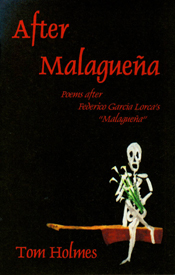
Tom Holmes’ Lorca-inspired and Death-suffused Malagueña sequence reads as a single poem, hypnotic in effect and delivering us to where “there’s a smell of salt / and women’s blood / from the feverish flowers / by the sea”; to where “there are mounds of dung / & lambs wool / piled in the seas / flooding the world”. Each section is a further location of this place in us where Death, who “sleeps / with orchids”, resides, the place of poetry itself.
— William Heyen, author Shoah Train, 2004 National Book Award Finalist. |
After Malagueña is both a deft formal homage to Lorca’s moody poem and a shrewd reinvention of it in contemporary guise: there’s an odor of sex / & rotting fish / from the beach / across the street // Death comes / once a week / to sing. ... In this stark, vivid sequence, Tom Holmes touches us with a hand as chilling as it is true. As the best poets always do, he sings not against death, but with it, reminding us of what we know.
— Stan Sanvel Rubin, author Five Colors.
Tom Homes has written a wonderfully comic and powerful invocation of Lorca in After Malagueña. Death appears in the most outrageous of places, not just in the bar of Lorca’s poem, but at a wedding, in the courtroom, and in the school where he “stays late / to clean erasers” — what wonderful irony: the great eraser cleans erasers! And in all the humor and close quarters of Lorca’s original form, there’s a dark reminder that Death is coming and leaving, and a reminder, too, of what poetry can do.
— Gerry LaFemina, author Window Facing Water, & editor Review Revue.
First Tom Holmes resurrects Lorca’s character Death in a new translation of “Malagueña,” then he follows as Death strolls from the bar in which Lorca found him out into a world as familiar and proximate as the grass stains on a child’s dress and as strange and obliterating as the seas flooding the world of our dreams. The patterns of these poems’ music comes in large measure from Lorca, but this is Death as Holmes knows him — revolutionary, educator, wedding guest, gig singer, unearther of orchids. This is a wonderful series, as companionable as it is haunting, and it marks the debut of a powerful new talent.
— Jonathan Johnson, author Mastodon, 80% Complete.
Who says you can’t quarrel with a translation and praise a new poet’s riffs on Lorca—all at the same time? In After Malagueña, Tom Holmes gives us thirteen sharp and disturbing ways of looking at Lorca. It’s good to have this new and intriguing work among us.
— Greg Glazner, author of From the Iron Chair, winner of The Walt Whitman Award, and Singularity.
After Malagueña is available at FootHills Publishing.
Slouching in the Path of a Comet by Mike Dockins. From Sage Hill Press. Order at sagehillpress@yahoo.com. Early Comments
"The poems in Mike Dockins' SLOUCHING IN THE PATH OF A COMET zoom effortlessly from gorgeous wide-angle shots to poignant close-ups. His irreverence is touching, his sincerity is peppered with a dark and delicious humor. These are poems of the self in the world and the world in the self. Dockins' debut is stylish, smart, and full of heart."
— Denise Duhamel
Two and Two (U of Pittsburgh P, 2005).
Queen for a Day: Selected and New Poems (U of Pittsburgh P, 2001).
"Mike Dockins has some serious chops, folks. These poems are properly irreverent, word- (and the sounds thereof) drunk, burning with rage, burning with tenderness, every atom of his imagination alert, i.e., he's a high octane young poet determined to make language matter. He does. He surely does."
— Thomas Lux
New and Selected Poems of Thomas Lux: 1975-1995 (Mariner Books, 1999).
The Street of Clocks (Mariner Books, 2003).
Reviews
An excellent review for Slouching in the Path of Comet was written by Man Martin and appears in the current issue of the American Book Review.

Site development by RareEdge